
Contents
- 🎵 Origins and Historical Context
- ⚙️ The Cognitive Mechanics of Executive Function
- 📊 Prevalence and Impact Statistics
- 👥 Key Researchers and Diagnostic Frameworks
- 🌍 Cultural Manifestations and Societal Impact
- ⚡ Current Understanding and Diagnostic Trends
- 🤔 Controversies and Diagnostic Debates
- 🔮 Future Directions in Research and Treatment
- 💡 Strategies for Seizing Opportunities
- 📚 Related Concepts and Further Exploration
- References
Overview
Early work by figures like Alexander Luria in the 1960s provided foundational insights into the brain regions responsible for goal-directed behavior and planning. The formalization of 'executive functions' as a set of cognitive processes gained traction through the work of Michael Posner and others. The recognition of disorders specifically impacting these functions, often termed 'dysexecutive syndrome,' became more prominent with the rise of neuropsychology. This historical trajectory highlights a growing awareness of how neurological differences can profoundly affect an individual's capacity to navigate complex tasks and seize opportune moments, a challenge central to the 'Don't Miss That Window' philosophy.
⚙️ The Cognitive Mechanics of Executive Function
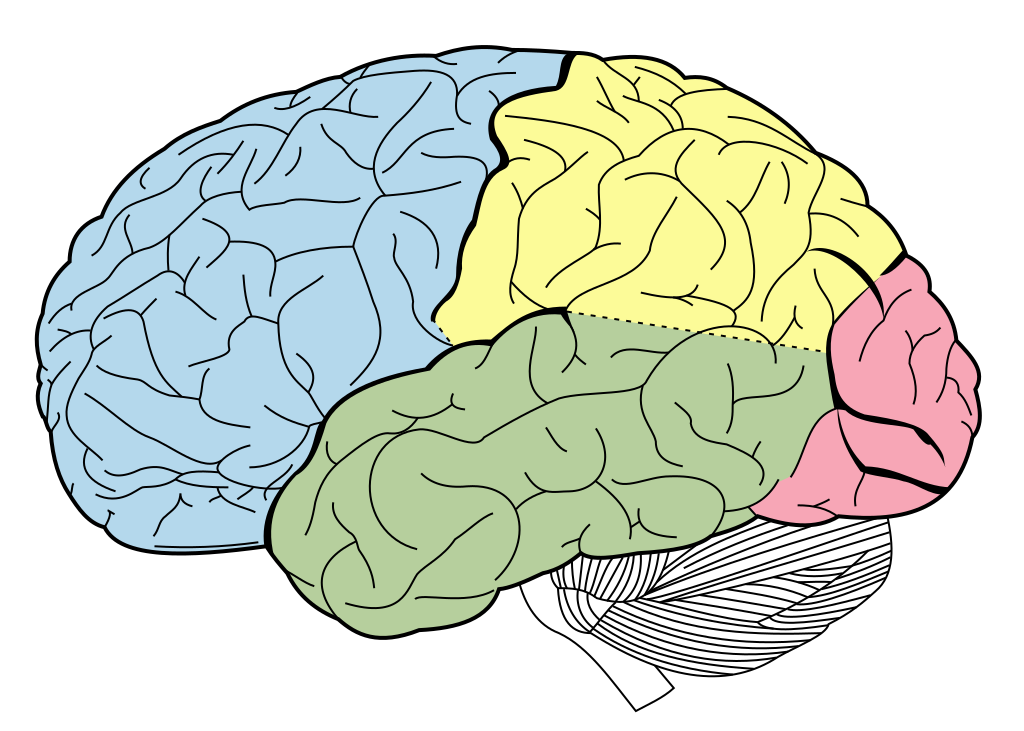
Executive function is the brain's command center, orchestrating complex cognitive processes essential for goal-directed behavior. The prefrontal cortex is widely considered the neural hub for these operations, making it particularly vulnerable to disruption.
📊 Prevalence and Impact Statistics
Individuals with autism spectrum disorder often exhibit challenges with cognitive flexibility and planning. Executive function impairments can arise from traumatic brain injuries, stroke, schizophrenia, and neurodegenerative diseases. The cumulative effect is a substantial public health concern, impacting educational attainment, vocational success, and overall quality of life, underscoring the critical need to address these challenges to prevent the chronic loss of potential opportunities.
👥 Key Researchers and Diagnostic Frameworks
The study of executive functions and their disorders has been shaped by numerous influential figures. Alexander Luria, a Soviet neuropsychologist, laid crucial groundwork by linking frontal lobe function to complex behaviors. Later, researchers like Michael Posner advanced our understanding of attention networks and cognitive control. Russell Barkley has been a leading proponent of the view that ADHD is fundamentally an executive function disorder. The DSM-5 is a key diagnostic framework used for diagnosing mental health conditions.
🌍 Cultural Manifestations and Societal Impact
The impact of executive function disorders extends far beyond individual struggles, shaping societal perceptions and interactions. In educational settings, students with these challenges may be mislabeled as lazy or unmotivated, failing to grasp the underlying cognitive barriers to task completion and timely submission. In the workplace, difficulties with organization and time management can hinder career progression, leading to missed promotions or job instability. Culturally, there's a pervasive emphasis on productivity and seizing the moment, which can exacerbate feelings of inadequacy for those whose brains are wired differently. This societal pressure can create a feedback loop of anxiety and avoidance, further diminishing the likelihood of individuals recognizing and capitalizing on opportune windows, making the 'Don't Miss That Window' ethos a source of stress rather than empowerment for many.
⚡ Current Understanding and Diagnostic Trends
Current research continues to refine our understanding of the neural underpinnings and heterogeneity of executive function disorders. Advances in neuroimaging techniques like fMRI and EEG are providing more precise maps of the brain networks involved. Diagnostic approaches are increasingly moving towards dimensional assessments rather than strict categorical diagnoses, acknowledging the spectrum of executive function abilities. Furthermore, there's a growing focus on the interplay between executive functions and other cog
🤔 Controversies and Diagnostic Debates
While debates continue regarding the precise definition and boundaries of executive function disorders, a key area of discussion revolves around the extent to which these deficits are primary or secondary to other conditions. Some argue that many observed executive function challenges are byproducts of underlying issues like anxiety or depression, while others maintain that core executive dysfunction is a distinct neurodevelopmental phenomenon. The heterogeneity of presentations also fuels debate, with researchers striving to create more nuanced classifications that capture the diverse ways these disorders manifest and impact individuals' ability to seize opportunities.
🔮 Future Directions in Research and Treatment
Future research is poised to delve deeper into the neurobiological mechanisms of executive function and its disorders. Personalized treatment approaches, leveraging genetic and neuroimaging data, are a significant area of focus. The development of novel therapeutic interventions, including advanced cognitive training programs and targeted pharmacological agents, aims to enhance executive skills. Furthermore, a greater emphasis on early identification and intervention is expected, particularly in at-risk populations, to mitigate the long-term impact on individuals' capacity to seize opportunities and achieve their potential.
💡 Strategies for Seizing Opportunities
Cognitive behavioral therapy (CBT) is a common therapeutic approach for executive function challenges. Mindfulness-based interventions can help improve attention and impulse control. Medication, such as stimulants, can be prescribed to manage ADHD symptoms. Organizational strategies and environmental modifications can support individuals with executive function deficits. The 'Don't Miss That Window' philosophy emphasizes seizing every opportunity before it's too late. Difficulty with initiation is a common symptom of executive function disorders. Cognitive flexibility deficits hinder adaptation to changing circumstances.
Key Facts
- Category
- science
- Type
- topic