
Contents
Overview
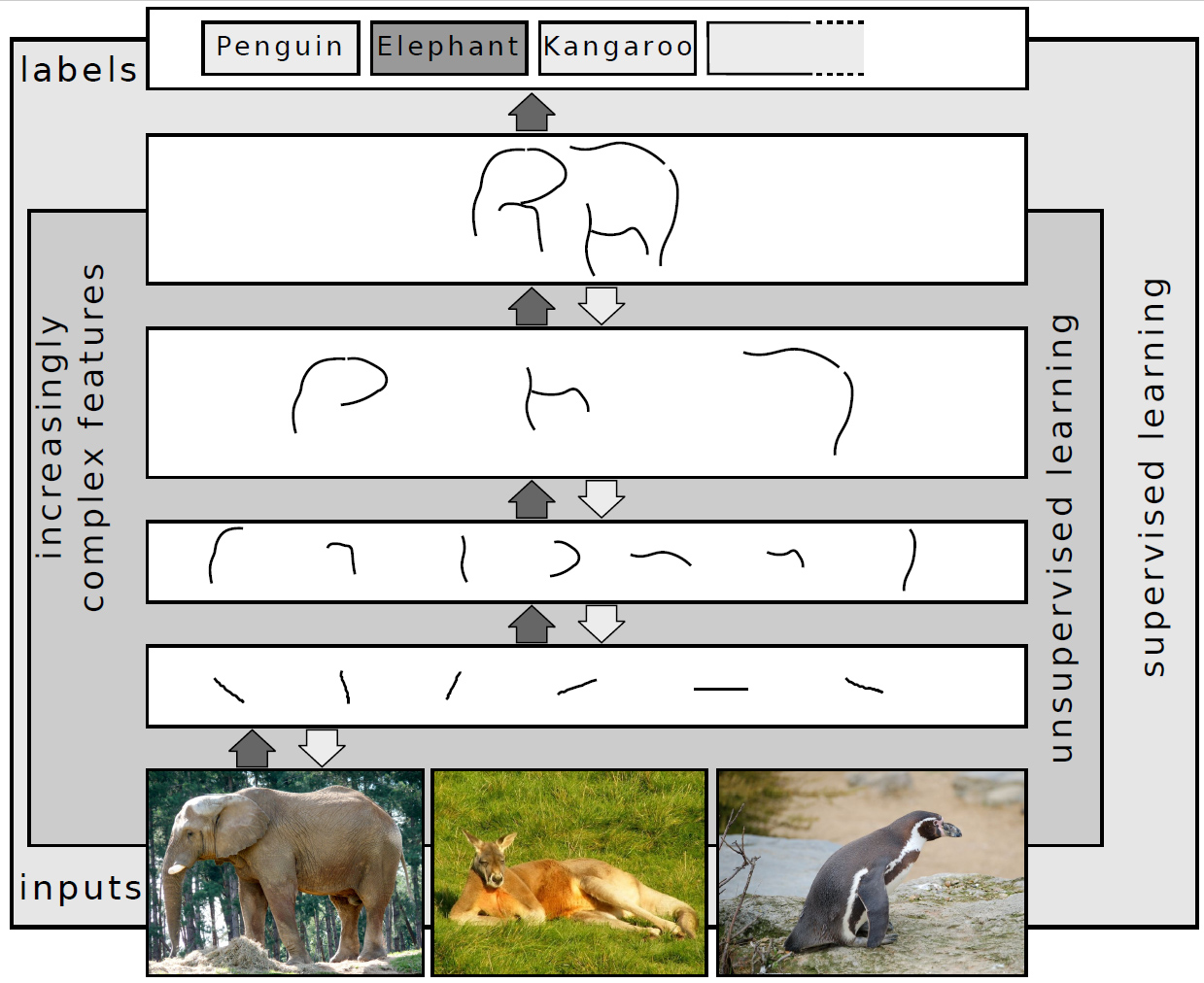
Deep learning models function by processing data through a series of interconnected artificial neurons organized into layers. Each neuron receives input, applies a weighted sum, and passes the result through an activation function to produce an output. In a deep network, data flows sequentially through multiple hidden layers, with each layer learning increasingly abstract representations of the input. During training, a loss function quantifies the error between the model's predictions and the actual outcomes, and the backpropagation algorithm adjusts the weights of the connections between neurons to minimize this error. Architectures like Convolutional Neural Networks (CNNs) are adept at processing grid-like data such as images, while Recurrent Neural Networks (RNNs) excel at sequential data like text and speech, and Transformers have revolutionized NLP tasks.
⚙️ How It Works
The scale of deep learning is staggering. Training these models often requires immense computational power, with large-scale training runs consuming hundreds of GPUs for weeks, costing millions of dollars. The ImageNet dataset, a benchmark for image recognition, contains over 14 million images. In 2023, the global market for AI, heavily driven by deep learning, was estimated to be worth over $200 billion, with projections reaching over $1.5 trillion by 2030. The number of AI research papers published annually has grown exponentially, exceeding 100,000 in recent years.
📊 Key Facts & Numbers
Pioneers like Geoffrey Hinton, often called a 'godfather of deep learning', alongside Yann LeCun (creator of CNNs) and Yoshua Bengio, were awarded the Turing Award in 2018 for their foundational contributions. Major tech companies like Google, Meta, Microsoft, and NVIDIA are at the forefront, investing billions in deep learning research and development, and releasing powerful open-source frameworks such as TensorFlow and PyTorch. Academic institutions like the University of Toronto, New York University, and MILA (Montreal Institute for Learning Algorithms) are crucial hubs for training new talent and pushing theoretical boundaries.
👥 Key People & Organizations
Deep learning has profoundly reshaped numerous cultural and technological landscapes. Its ability to power virtual assistants like Siri and Alexa has made AI a household presence. In entertainment, deep learning algorithms recommend content on platforms like Netflix and YouTube, influencing consumption habits. The rise of AI-generated art and music, facilitated by models like GANs, has sparked debates about creativity and authorship. Furthermore, deep learning's role in advancing autonomous driving technology and personalized medicine is fundamentally altering industries and daily life, making AI a pervasive, albeit often invisible, force.
🌍 Cultural Impact & Influence
The field is in a state of rapid evolution, with a strong focus on developing more efficient and interpretable models. Research into Explainable AI (XAI) aims to demystify the decision-making processes of deep learning models, addressing concerns about their 'black box' nature. The development of foundation models like GPT-4 and Google's Bard represents a significant trend, with these large, pre-trained models being adapted for a wide range of downstream tasks. Edge AI, enabling deep learning inference directly on devices like smartphones and IoT sensors, is gaining traction, reducing reliance on cloud computing. Ethical considerations, including bias in datasets and potential misuse, remain a critical area of ongoing development and public discourse.
⚡ Current State & Latest Developments
Significant controversies surround deep learning, particularly concerning algorithmic bias. The 'black box' problem, where the internal workings of complex deep learning models are opaque, raises concerns about accountability and trust, especially in high-stakes applications like healthcare and autonomous systems. Debates also persist regarding the environmental impact of training massive models, which consume substantial amounts of energy. Furthermore, the potential for deepfakes and AI-generated misinformation poses a threat to public discourse and trust.
🤔 Controversies & Debates
The future of deep learning points towards increasingly sophisticated and integrated AI systems. We can anticipate further advancements in reinforcement learning, enabling AI agents to learn complex tasks through trial and error in simulated or real-world environments. The convergence of deep learning with other AI techniques, such as symbolic AI, may lead to more robust and generalizable intelligence. Continued progress in neuromorphic computing could offer hardware solutions for more energy-efficient deep learning. Experts predict that by 2030, deep learning will be integral to most major technological advancements, driving personalized experiences, scientific discovery, and automation across virtually every sector.
🔮 Future Outlook & Predictions
Deep learning's practical applications are vast and growing. In healthcare, it powers diagnostic tools for analyzing medical images like X-rays and MRIs, aiding in early disease detection. The finance industry uses it for fraud detection, algorithmic trading, and credit scoring. Retailers leverage deep learning for personalized recommendations, inventory management, and supply chain optimization. In manufacturing, it's employed for quality control, predictive maintenance, and robotic automation. The entertainment industry uses it for content generation, special effects, and personalized streaming experiences. Even in scientific research, deep learning accelerates discovery in fields like drug development and climate modeling.
💡 Practical Applications
Deep learning is a cornerstone of modern artificial intelligence and machine learning. It shares conceptual links with computational neuroscience due to its inspiration from biological neural networks. Understanding deep learning is crucial for grasping the capabilities of related technologies like NLP and computer vision. For those interested in the underlying hardware, exploring GPUs and TPUs is essential. Further reading could delve into specific architectures like CNNs or RNNs, or explore the ethical dimensions of AI ethics.
Key Facts
- Category
- technology
- Type
- topic