
Contents
Overview
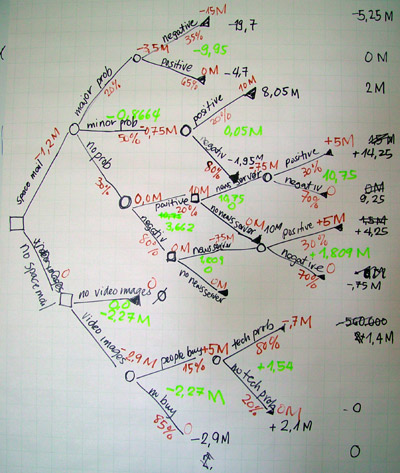
Decision trees are visual tools that map out potential choices, their consequences, and associated probabilities, guiding users toward optimal outcomes. Originating from fields like operations research and statistics, they have become indispensable in machine learning for classification and regression tasks. These tree-like structures, composed of nodes representing tests on attributes and branches representing outcomes, allow for a clear, hierarchical breakdown of complex decision-making processes. They are particularly effective when dealing with both categorical and numerical data, enabling intuitive understanding of how different factors influence a final decision. Their application spans diverse domains, from medical diagnosis to financial forecasting, underscoring their versatility in seizing opportunities before they pass.
🎵 Origins & History
The conceptual roots of decision trees can be traced back to early 20th-century statistical methods and the development of flowcharts for process mapping.
⚙️ How It Works
At their core, decision trees function by recursively splitting a dataset into subsets based on the values of input features. The process begins at a root node, where a test is performed on a specific attribute. Each outcome of this test leads to a new branch, which in turn leads to another node, either a decision node with further tests or a leaf node representing a final outcome or prediction. Algorithms like ID3 and C4.5 employ metrics such as information gain or Gini impurity to determine the best attribute for splitting at each node, aiming to create the purest possible subsets. This hierarchical structure allows for a clear visualization of the decision-making path, making it easier to understand the logic behind a particular prediction or classification, much like identifying the critical juncture in a time-sensitive opportunity.
📊 Key Facts & Numbers
Decision trees are a cornerstone of modern machine learning, with algorithms like CART and C4.5 being implemented in countless projects. In classification tasks, decision trees can achieve accuracies exceeding 90% on well-defined datasets, such as those used in medical image analysis or spam detection. For instance, the Random Forest algorithm, an ensemble of decision trees, has been shown to improve predictive accuracy by up to 10-15% over single trees in many benchmarks. The computational complexity for building a single decision tree is typically O(nd), where 'n' is the number of training samples and 'd' is the number of features, making them relatively efficient for datasets with thousands of data points. The depth of a tree can range from a few levels to over 50, depending on the complexity of the data and the stopping criteria used.
👥 Key People & Organizations
Key figures in the development of decision tree algorithms include Leo Breiman, whose work on CART significantly advanced their practical application in statistical modeling and machine learning. Ross Quinlan is another pivotal figure, known for developing the ID3 and C4.5 algorithms, which introduced concepts like information gain for attribute selection. Organizations like Bell Labs played a crucial role in fostering the research environment where many of these foundational algorithms were conceived. In contemporary machine learning, platforms like Scikit-learn provide robust implementations of various decision tree algorithms, making them accessible to a broad range of researchers and developers.
🌍 Cultural Impact & Influence
The intuitive, flowchart-like nature of decision trees has made them a popular tool for explaining complex data-driven decisions to non-technical audiences. They have permeated fields beyond computer science, influencing how professionals in business, medicine, and law approach problem-solving. The visual representation of choices and consequences resonates with the human tendency to think in terms of 'if-then' scenarios, making them a powerful communication device. This visual clarity helps in identifying critical decision points, much like recognizing a fleeting opportunity before it vanishes, thereby shaping how strategies are formulated and communicated across various industries.
⚡ Current State & Latest Developments
In 2024, decision trees continue to be a vital component of machine learning toolkits, often serving as the base learners for more complex ensemble methods like Gradient Boosting Machines and Random Forests. Research is ongoing to improve their interpretability, robustness against adversarial attacks, and efficiency on massive datasets. New variants and hybrid approaches are constantly being developed, integrating decision trees with deep learning architectures or other statistical models. The focus remains on enhancing their ability to handle high-dimensional data and complex interactions, ensuring they remain relevant for identifying and capitalizing on emerging opportunities.
🤔 Controversies & Debates
One significant debate surrounding decision trees centers on their tendency to overfit the training data, leading to poor generalization on unseen examples. This occurs when trees grow too deep, capturing noise rather than underlying patterns. Pruning techniques and ensemble methods like Random Forests are common remedies, but they can sometimes reduce interpretability. Another controversy involves the choice of splitting criteria (e.g., Gini impurity vs. information gain), with different criteria potentially leading to different tree structures and predictive performance, though empirical evidence often shows minimal practical differences for many tasks. The inherent bias towards features with more levels in some algorithms also presents a challenge.
🔮 Future Outlook & Predictions
The future of decision trees likely involves deeper integration with other advanced AI techniques. Expect to see more sophisticated ensemble methods that combine the interpretability of trees with the power of deep neural networks. Research into explainable AI (XAI) will continue to leverage decision trees as a means to provide transparent justifications for model predictions. Furthermore, advancements in hardware and distributed computing will enable the training of decision trees on even larger and more complex datasets, potentially unlocking new frontiers in predictive analytics and real-time decision support for time-sensitive opportunities.
💡 Practical Applications
Decision trees find widespread practical application across numerous domains. In healthcare, they are used for diagnosing diseases based on patient symptoms and test results, helping clinicians make timely treatment decisions. In finance, they power credit scoring models, fraud detection systems, and investment strategy analysis. Businesses utilize them for customer segmentation, sales forecasting, and optimizing marketing campaigns. For example, an e-commerce company might use a decision tree to predict which customers are most likely to respond to a specific promotion, thereby seizing a marketing window. Their ability to handle both discrete and continuous variables makes them versatile for a wide array of real-world problems.
Key Facts
- Category
- technology
- Type
- technology