
Contents
Overview
Climate change refers to significant, long-term shifts in global weather patterns. The consequences are far-reaching, manifesting as more frequent heat waves, intensified wildfires, and altered precipitation patterns, impacting ecosystems and human societies alike. Understanding and addressing climate change is critical to seizing opportunities for a sustainable future before irreversible thresholds are crossed.
📖 Definition & Core Concept
Climate change, in the context of seizing opportunities, is the observable, long-term alteration of Earth's climate system. This phenomenon demands urgent attention, as the window to mitigate its most severe impacts is rapidly closing, requiring proactive measures and innovative solutions to secure a viable future.
🔬 How It Works (Mechanics)
The mechanics of climate change hinge on the greenhouse effect. Deforestation further exacerbates this by removing trees that absorb CO2. This warming then drives a cascade of changes in weather patterns, ocean currents, and ice cover.
📊 Key Facts, Numbers & Statistics
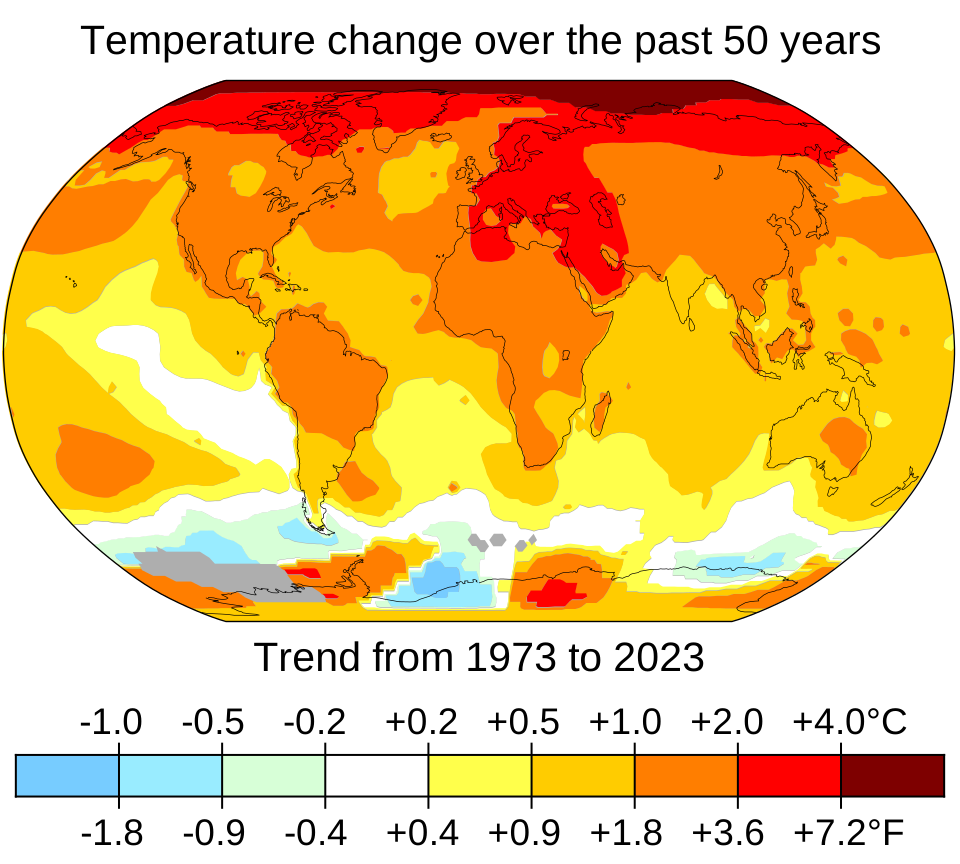
The atmospheric concentration of carbon dioxide has increased by approximately 50% since the pre-industrial era, according to data from ice cores. Global average temperatures have risen by about 1.1 degrees Celsius (2 degrees Fahrenheit) since the late 19th century, with the most significant warming occurring in the last few decades. The Arctic is warming at more than twice the global average rate. Extreme weather events, such as heat waves, are becoming more frequent and intense; for instance, the number of days with extreme heat has doubled in many regions since the 1980s. The IPCC reports that human activities are unequivocally the cause of observed warming.
🌍 Real-World Examples & Use Cases
The impacts of climate change are already visible across the globe. Coastal cities like Miami are experiencing more frequent sunny-day flooding due to rising sea levels, impacting infrastructure and real estate. The melting of permafrost in Siberia and Alaska releases trapped methane, creating a dangerous feedback loop that accelerates warming. These are not isolated incidents but interconnected symptoms of a global phenomenon demanding immediate action.
📈 History & Evolution
While Earth's climate has always changed naturally over geological timescales, the current rapid warming trend is unprecedented in its speed and cause. Early scientific understanding of the greenhouse effect dates back to Svante Arrhenius in 1896. Widespread scientific consensus and public awareness began to solidify in the latter half of the 20th century, spurred by data from organizations like the NASA and the development of climate models. The establishment of the IPCC in 1988 marked a critical step in consolidating global scientific understanding and informing policy, though debates over the pace and severity of impacts have persisted.
⚡ Current State & Latest Developments
The current state of climate change is characterized by accelerating impacts and a growing urgency for mitigation and adaptation. Global temperatures continue to climb, with recent years consistently ranking among the hottest on record. International efforts, such as the Paris Agreement of 2015, aim to limit warming to well below 2 degrees Celsius, preferably to 1.5 degrees Celsius, compared to pre-industrial levels. However, current national commitments (NDCs) are insufficient to meet these goals. Innovations in renewable energy technologies like solar power and wind power are rapidly advancing, offering potential solutions, but their deployment must outpace fossil fuel consumption significantly. The focus is increasingly shifting towards climate adaptation strategies to cope with unavoidable changes.
🔮 Why It Matters & Future Outlook
Climate change presents both existential threats and significant opportunities. For governments and businesses, it necessitates a transition to sustainable development, driving innovation in green technology, energy efficiency, and circular economy principles. For individuals, it means re-evaluating consumption patterns and advocating for policy changes. The future hinges on our collective ability to seize the 'window of opportunity' to decarbonize economies and build resilience. Failure to act decisively could lead to irreversible environmental damage, mass displacement, and geopolitical instability, while proactive engagement can foster a more equitable and sustainable world.
🤔 Common Misconceptions
A common misconception is that climate change is a distant future problem or a natural cycle that humans can't influence. In reality, the current warming trend is occurring at a rate far exceeding natural cycles. Scientific evidence overwhelmingly points to human activity as the primary driver. Another misconception is that addressing climate change will cripple economies; however, many analyses suggest that the cost of inaction far outweighs the cost of transitioning to a green economy, creating new jobs and industries in renewable energy and sustainable infrastructure. Finally, some believe individual actions are insignificant, but collective behavioral shifts, amplified by policy, can drive substantial change.
Key Facts
- Category
- definitions
- Type
- concept
- Format
- what-is