
Contents
Overview
Business continuity planning (BCP) is the proactive process of establishing systems and protocols to ensure an organization can maintain essential functions during and after disruptive events. It's not merely about disaster recovery, but about the overarching capability to continue delivering products or services at acceptable levels when faced with threats ranging from cyberattacks to natural disasters. Effective BCP identifies critical business processes, assesses potential risks, and develops strategies for prevention, mitigation, and rapid recovery. The ultimate goal is to minimize downtime, protect assets, and preserve stakeholder confidence, transforming potential crises into manageable challenges. This strategic foresight allows businesses to not just survive disruptions, but to emerge stronger and seize opportunities that others miss.
🎵 Origins & History
The roots of business continuity planning can be traced back to early 20th-century industrial resilience efforts, particularly in the wake of World War I and II, which highlighted the vulnerability of supply chains and infrastructure. Early forms focused on physical security and maintaining production lines against wartime disruptions. Business continuity planning has evolved significantly, driven by increasing reliance on technology and a growing awareness of risks like terrorism and widespread power outages. Organizations have emerged to standardize practices and promote professional development, solidifying BCP as a critical component of corporate governance and risk management.
⚙️ How It Works
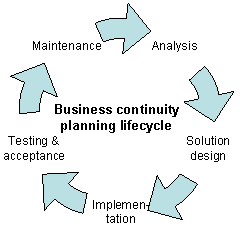
At its core, business continuity planning involves a systematic cycle that begins with a business impact analysis (BIA) to identify critical functions and their dependencies, followed by a risk assessment to pinpoint potential threats and their likelihood. Based on these findings, strategies are developed, which can include preventative measures (e.g., redundant systems, cybersecurity protocols), mitigation tactics (e.g., alternate work sites, supply chain diversification), and recovery plans (e.g., data restoration, crisis communication). These plans are then documented, tested regularly through simulations and drills, and maintained through periodic reviews and updates. Key components often include crisis management, disaster recovery, and communication plans, ensuring a coordinated response across all organizational levels, much like how Netflix ensures streaming availability even during peak demand.
📊 Key Facts & Numbers
Business continuity planning has influenced corporate governance, with boards of directors increasingly scrutinizing an organization's preparedness for disruptions. The COVID-19 pandemic is cited as a lesson learned for supply chain resilience, emphasizing the need for robust BCP. Cloud-based BCP solutions are becoming standard, offering scalability and accessibility. There's also a growing emphasis on supply chain resilience, driven by lessons learned from global disruptions. Organizations are investing more in employee well-being and mental health support as part of their continuity strategies, recognizing that human capital is as critical as technological infrastructure.
👥 Key People & Organizations
One persistent debate in BCP centers on the balance between preparedness and cost. Critics argue that extensive BCP can be prohibitively expensive, especially for smaller businesses, and that resources might be better allocated elsewhere. There's also contention over the effectiveness of testing; while simulations are crucial, some argue they don't fully replicate the chaos of a real-world disaster. Another point of friction is the scope: should BCP focus solely on operational continuity, or also encompass reputational risk and stakeholder management? Furthermore, the increasing sophistication of cyber threats, particularly ransomware attacks, challenges traditional BCP models, leading to discussions about whether prevention or rapid, effective recovery is the more critical element. The debate intensifies when considering the potential for 'black swan' events, which are inherently unpredictable.
🌍 Cultural Impact & Influence
The future of business continuity planning points towards hyper-personalization and proactive, predictive resilience. AI will likely play an even larger role, enabling real-time risk assessment and dynamic plan adjustments. We can expect a greater convergence of BCP with cybersecurity, operational risk management, and environmental, social, and governance (ESG) initiatives. The concept of 'resilience-as-a-service' may become more prevalent, offering tailored BCP solutions on demand. As climate change impacts intensify, BCP will increasingly incorporate climate risk assessments and adaptation strategies. The ultimate goal will be to build organizations that are not just resistant to disruption but are inherently agile and capable of continuous adaptation, turning unforeseen events into strategic advantages, much like how Tesla leverages manufacturing innovations to adapt to market shifts.
⚡ Current State & Latest Developments
Business continuity planning has direct applications across virtually every sector. In finance, it ensures the stability of trading platforms and transaction processing during market volatility or cyber incidents, as exemplified by Nasdaq's robust systems. Healthcare organizations use BCP to maintain patient care, manage critical medical equipment, and protect sensitive health records during emergencies, a vital function for institutions like the Mayo Clinic. Retailers employ BCP to keep supply chains moving and online stores operational during peak seasons or unexpected disruptions, a strategy crucial for companies like Walmart. Technology companies rely heavily on BCP for data integrity, system uptime, and rapid recovery from outages, a necessity for service providers like Microsoft. Even non-profits utilize BCP to continue delivering essential services to their communities during crises.
🤔 Controversies & Debates
Business continuity planning is intrinsically linked to risk management, forming a critical subset of a broader strategy to protect organizational assets and operations.
Key Facts
- Category
- technology
- Type
- topic